
Beyond the Postures: Svadhyaya and the Practice of Looking Within
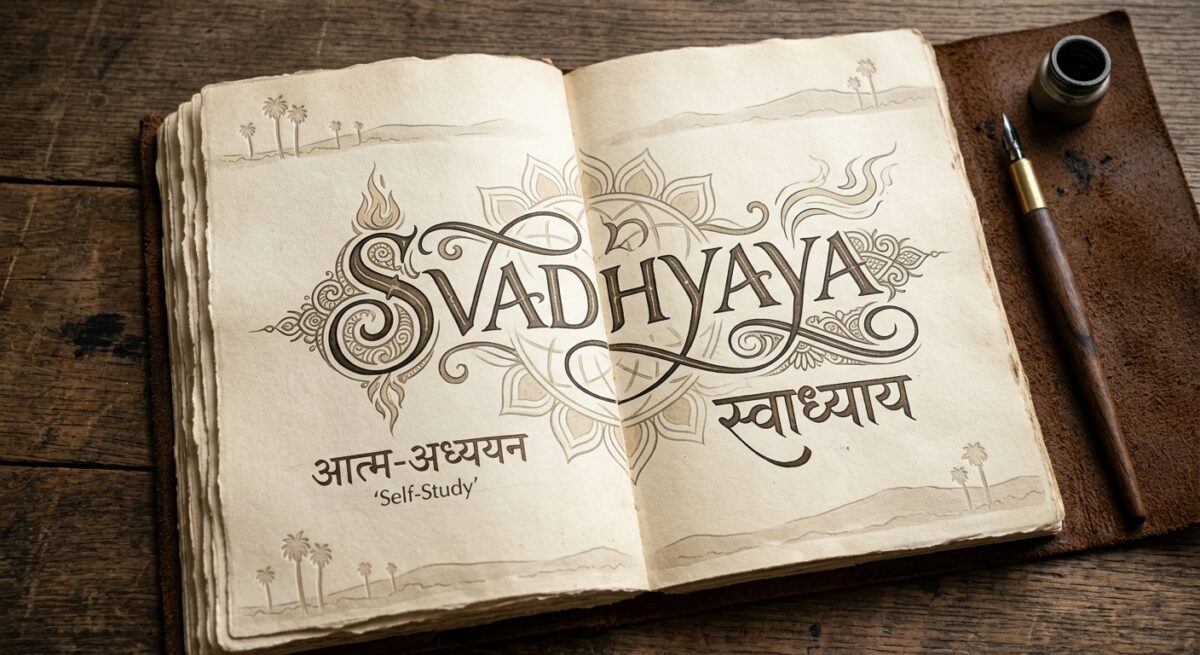
“svādhyāyād iṣṭadevatā-samprayogaḥ” Sutra II.44, Yoga Sutras, Patanjali
“From self-study comes communion, or alignment, with one’s chosen deity or higher ideal”
This sutra (verse) gives the explanation of the concept of Svadhyaya in the foundational text of classical yoga philosophy, the Yoga Sutras of Patanjali. Let’s discuss how this concept of Yoga, which is personally one of my favourites, can help us unlock the wisest version of our inner self through honest introspection.
I am a child of survivors of the Khmer Rouge genocide. Under the Khmer Rouge regime in Cambodia in the late 1970s, nearly two million people were killed through mass executions, starvation, and forced labor. Families were completely torn apart.

My own family lost many members during this dark era. Growing up, the brutal accounts of how they survived became my “bedtime” stories. Strange I know.
I had always heard about this cruel genocide, but I never really felt it until I stayed for half a year teaching Yoga in a resort in rural Cambodia.
This is where the concept of Svadhyaya becomes relevant. A Sanskrit word for “self-study” or “self-reflection,” Svadhyaya is part of the Niyamas, which form the second pillar of yoga and serve as the inner disciplines for our mind and character. While Svadhyaya traditionally means studying sacred texts, its real-world application is about turning the lens inward. It is the discipline of studying how our own mind works—both on the yoga mat as we practice asanas, and beyond the mat.
Yoga is never just physical movement, it naturally intertwines with the deep and quiet work of the inner self.
Walking Beside the Ghosts of the Past
When I told my father I was teaching in a resort near Kampong Cham, surrounded by cashew plantations and durian groves, he told something that froze my heart : this was the exact region where his mother, my paternal grandmother was killed during the Khmer Rouge regime.
 Outside of teaching my morning and afternoon classes, I had hours of free time to watch the landscape and listen to the wind. Anywhere else, this routine would have been a peaceful sanctuary—and at times, it was. But because the resort was built near the local Wat (temple), my daily morning walks took me past numerous tombs and stupas. Walking among these resting places, the physical presence of death was everywhere around me, quietly triggering a deeper process within.
 The silence of the fields projected me into my family’s past I had heard about my entire life. Suddenly, the serene landscape around me shifted: the green fields became the land where my mother laboured barefoot under a crushing sun. The lush imperial forest where I took morning walks became the dark woods where my mother was once lost and terrified as a young girl, having already lost her father and siblings.
Nature had always been my sanctuary and playground. Here, for the first time, I understood at my core why my mother was never drawn to nature walks the way I was.

Facing My Parents’ Past
My dad rarely spoke of his mother, whom he lost during the Khmer Rouge regime. She and her two youngest sons were staying in a different location, away from the rest of my dad’s family who survived. Growing up, I heard plenty of stories about my mother’s family, but almost nothing about my father’s mother. It had never occurred to me to question this difference in treatment.
Being in the exact area where she died suddenly brought her memory to life, and I began to feel a profound sadness for my dad. I felt heartbroken seeing how deeply carrying that unspoken grief had weighed on him—a devastating loss he may never have truly overcome, even forty years later.
I started thinking about what my grandmother’s life must have been like. I began seeing her face in every village woman I passed. I thought of the terror she must have felt, forced to leave her home alone with her two young sons while the rest of her family was scattered across the country.
I thought of my dad’s lifelong pain of never seeing his mother again, and of the peaceful life she could have had.
 Holding these thoughts close was how I finally paid tribute to her. Sitting quietly in that landscape, I offered her and my two young uncles the presence and honor they were denied in life. I saw myself in her: a traveler navigating distant places alone.
Connecting with her memory through quiet reflection gave me an invisible, eternal bond. Though I never met her, she finally held a clear, honored place in my heart.
Turning the Lens Inward: A Call to Self-Study
I had heard and studied Svadhyaya for years in yoga schools and books. But here, this was life bringing me face to face into an unscripted and intimate encounter with my own roots.
It made me think of Mark Wolynn’s book about how inherited trauma shapes who we are, It Didn’t Start with You.
He points out a striking biological fact: when a grandmother is pregnant with her daughter, the egg that will eventually become her grandchild is already present.
Reflecting on this brought my thoughts to my grandmother on my mother’s side. I had always been so close to her and she passed away three years back, yet standing there, I realized with regrets that I actually knew so little about her life besides the tragedy of the Khmer rouge regime. Walking through that countryside, I asked myself : How was her life when she was pregnant with my mum? How was she really feeling?
I realized that ignoring our family’s past often comes from our own fear of facing that pain. By finally looking into these unspoken stories, I ended up unlocking heavy feelings in myself I didn’t even know I was carrying.
This was Svadhyaya in practice—not just a theory on a page.
This is the beauty and the gift of Yoga: it is not only a practice on the mat or theory on paper, but a practical daily application.

If you practice yoga or simply want to understand yourself better, looking at your own lineage is a powerful place to start. Ask yourself :
What stories or silences are living inside your body that might belong to those before you?
Are there any ancestral wounds or unresolved traumas in your lineage that you might be carrying?
What is a recurring argument, habit, or problem in your family that keeps happening over and over, as if everyone is just sweeping a deeper and unspoken pain under the rug?
Last posts
Yoga and Cycling : How Yoga Made Be A Better Cyclist
Part I: The Body — How Yoga Complements Cycling How yoga can improve mobility, body awareness and balance on and off the bike. I used to think that cyclists in [...]
My week at the Divine Life Society (Sivananda Ashram) : Part III
"Sow love, reap peace. Sow meditation, reap wisdom" - Swami Sivananda From Hatha Yoga to Bhakti Yoga I practise Yoga postures (Yoga Asanas) almost every day, even if it’s just [...]
My week at the Divine Life Society (Sivananda Ashram) : Part II
“Fewer the thoughts, greater the peace.” Swami Sivananda Arrival at the Ashram After a long journey by bus and then by rickshaw, I arrived in front of this orange facade [...]
My Week at the Divine Life Society (Sivananda Ashram, Rishikesh) Part I
"Let your eyes look with kindness, your tongue speak with sweetness, and your hand serve with softness" Swami Sivananda During my last trip to India, I had the incredible opportunity [...]
Serving a Vipassana Course: The Ultimate Yoga Practice
Anyone who has completed a 10-day Vipassana course alongside a dedicated yoga practice will tell you: Vipassana is the holy grail of Yoga. You can read about my first Vipassana [...]

Yoga Is Not Everything
When I chat with students or people who would like to start Yoga, I sometimes hear: "I need to do yoga." This use of the word "need" makes me thoughtful. [...]

Beyond the Postures: Svadhyaya and the Practice of Looking Within
"svādhyāyād iṣṭadevatā-samprayogaḥ" Sutra II.44, Yoga Sutras, Patanjali "From self-study comes communion, or alignment, with one's chosen deity or higher ideal" This sutra (verse) gives the explanation of the concept of [...]


Teaching Yoga in a Resort in Cambodia
I moved to Cambodia with a naive dream: to connect with my roots. Being born in Paris to Cambodian parents, growing up in France, and studying in Germany. I was [...]


Is Yoga A Sport?
Yoga Is Not a Sport - Said My Doctor I started Yoga with a few irregular sessions in a yoga studio in North Shore Auckland and online. At the time, [...]
My First Vipassana Retreat
On a quiet night beneath the Bodhi tree, Gautama Buddha closed his eyes—not to escape the world, but to see it so clearly that suffering itself dissolved. My journey from [...]