
My week at the Divine Life Society (Sivananda Ashram) : Part II
“Fewer the thoughts, greater the peace.” Swami Sivananda
Arrival at the Ashram
After a long journey by bus and then by rickshaw, I arrived in front of this orange facade that had once been a source of fantasies and mysteries. This time, for the very first time with a hint of intimidation, I crossed the doorstep of the reception.
Two men in “Indian robes”—one in white, another in orange—greeted me. With my hair messy and all over the place after a full day of travel, and wearing my sports t-shirt, I felt like an intruder, a tourist who had gotten lost here. On the contrary, and to my great relief, the men were very welcoming and registered me.
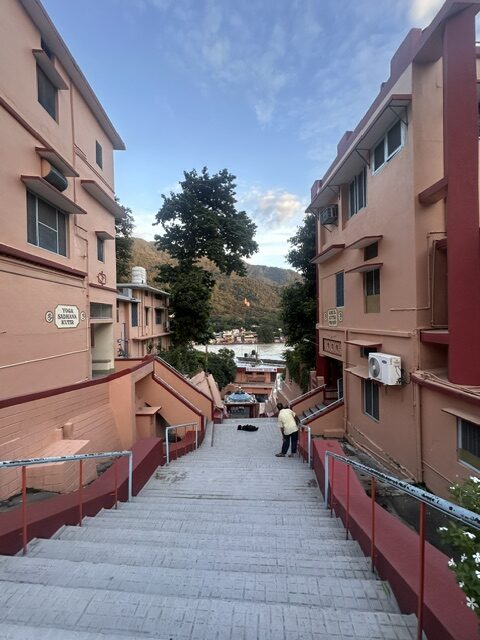
Discovering the Ashram Grounds
To enter the ashram, which sat directly across the street from the reception, I had to cross the busy and dusty road and climb a grand set of stone stairs.
Climbing those steps—which revealed a peaceful and “humble” view of the Ganges river at the back—felt like crossing a portal from a loud, frantic world into a space of profound peace and holiness. The road I left behind was always chaotic, buzzing with cars and a constant chorus of blaring horns.
Once I reached the top of the stairs, I stepped onto an immaculate courtyard paved with smooth white marble. The surrounding residential blocks, bearing names like Yoga Sadhana and Laxmi Kutir, quickly reminded me of the sacred nature of these grounds.
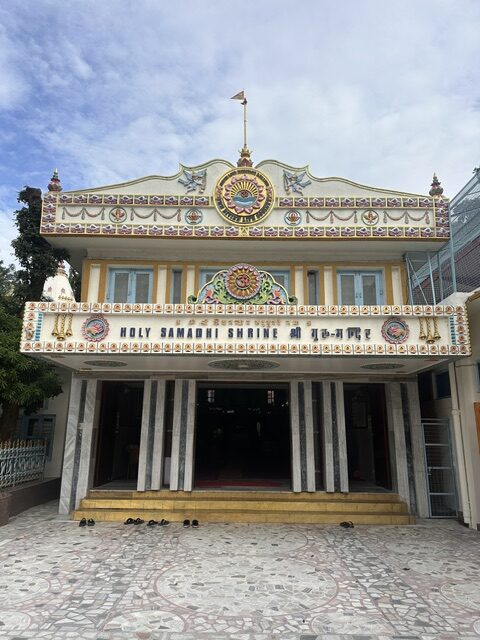
My room : the Hermitage of Raja Yoga
I walked in to discover my living quarters for the upcoming week. The room was the very definition of minimalist: two simple wooden single beds topped with very thin mattresses. There were no blankets, but because the Indian heat was so intense, I guess I wouldn’t need them.
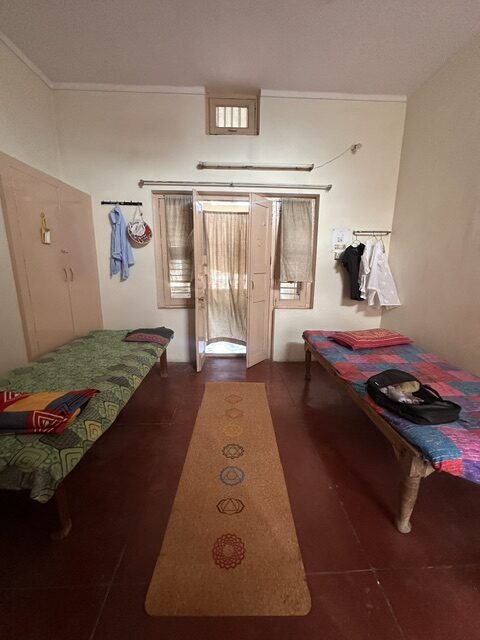
The bathroom was small but perfectly clean. The rest of the furniture consisted of a long table to arrange my belongings and two basic chairs. It was absolutely perfect; I needed nothing else. There, three traditional meals were provided for us every single day.
In the first part of this article about my stay, I mentioned Raja Yoga. This room perfectly represented that branch of yoga and fit the exact imagery you would expect from an ashram: a path of mental discipline and austerities (Tapas).
Stripped of all modern distractions, screens, and luxuries, the stark simplicity of the space forced one’s attention inward and toward the devotional atmosphere of the ashram.
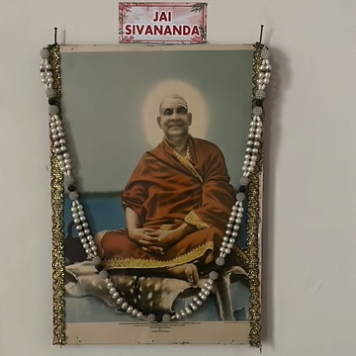 An equally important element was the portrait of the founder and Guru, Swami Sivananda. It was the room’s sole ornament, hanging on the wall right beside the bed I had chosen.I must admit that this portrait on the wall divided me between two emotions.
On one hand, I felt a deep respect for the man who had been the source of this magnificent and undeniably serene ashram. On the other hand, I felt a certain skepticism (undoubtedly tied to my French upbringing) toward anything that felt like a cult of personality.
Who was this Sivananda? This same portrait had been on the front page of multiple yoga books I had read, but in reality, I didn’t know much about him. What had he actually done to be so deeply revered nearly 63 years after his death? I decided to get to know Swami Sivananda by heading toward a central place in the ashram: the library.
Studying at the Ashram Library: The Pursuit of Jnana Yoga
“Better be unborn than untaught for Ignorance is the root of all misfortunes” – Plato
One of the places where I spent the vast majority of my days was the ashram library. Because the founder, Swami Sivananda, was globally renowned for his lifelong mission to disseminate and spread the knowledge of yoga, it is only natural that the ashram housed an incredibly exhaustive library. This room was the physical embodiment of Jnana Yoga—the path of intellectual inquiry and wisdom.
In fact, the night before, during my very first evening, I had been overcome with doubt during the Satsang (a nightly spiritual gathering filled with collective chanting and prayers). I didn’t feel like I belonged there; I felt uncomfortable and was thinking that maybe I should just join a physical Yoga Asana school while I was still in the yoga capital.
I devoured the book and read it in one sitting. Within two days, I had finished it and understood much better the devotion of the devotees and the monks who lived in the ashram. Swami Sivananda was a true Yogi, passionate about his subject, and dedicated to teaching, sharing, and helping everyone who chose the path of Yoga. His words seemed to transcend time to answer my own doubts.

To Be Served is the Most Humbling Experience
” Give your full heart, mind and soul. Do not care for results. Do not think of success or failure. Do not think of the past. Have complete confidence” – Swami Sivananda
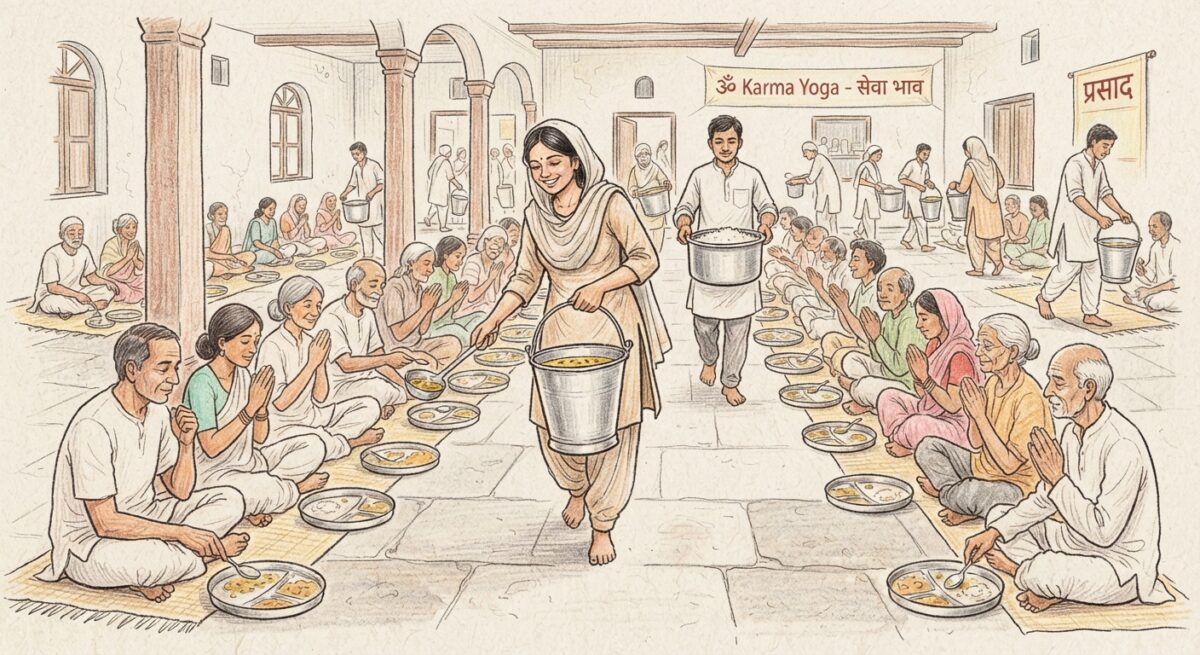
While the library engaged my mind, the dining hall soften my ego. In the dining hall, we ate sitting cross-legged on the floor, with men and women seated in completely separate rows. This space was the pulsing heart of Karma Yoga—the path of selfless service.
Before any food touched our plates, a Swami led us in chanting Hare Rama Hare Krishna, keeping the prayer going for several powerful minutes. As the chants echoed through the hall, a cohort of men carrying massive metal buckets moved swiftly down the rows to serve us fresh chapatis, rice, a mixed vegetable main dish, traditional dahl, and occasional side dishes.
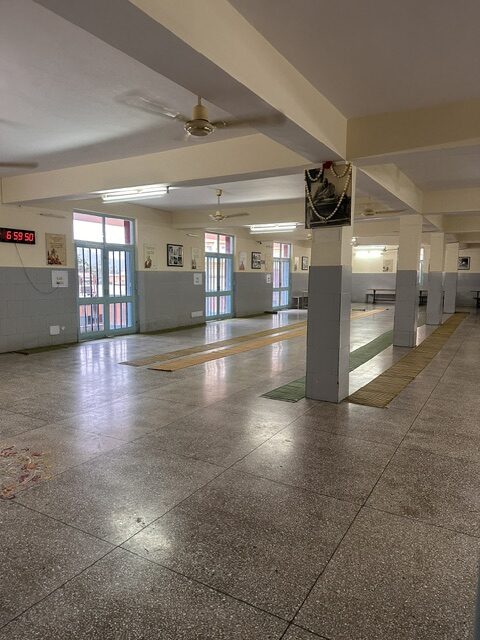 The moment the final prayer was recited by the Swami, the eating began. We had to be quick. There, we ate quickly and in silence. We were given exactly thirty minutes to finish before the next shift of servers, volunteers, staff, and latecomers arrived to eat. A few minutes into the meal, the servers rushed back down the rows to offer second helpings to anyone who needed them.
Watching these men working so tirelessly, buckets in hand, constantly bending low to our level on the floor to feed us, deeply moved me.
They had not even eaten yet themselves. To serve others with such genuine sincerity and attention, with an empty stomach but a completely full heart, was profound. In a world currently fractured by rising extremes and division in so many regions, witnessing this selfless care was enough to restore my faith in humanity.
In yoga philosophy, this beautiful practice is known as Karma Yoga. Karma Yoga is the spiritual path of selfless service. It means acting with entirely pure intentions, fulfilling your duty, and lifting others up without ever expecting a single word of praise, reward, or personal gain in return.
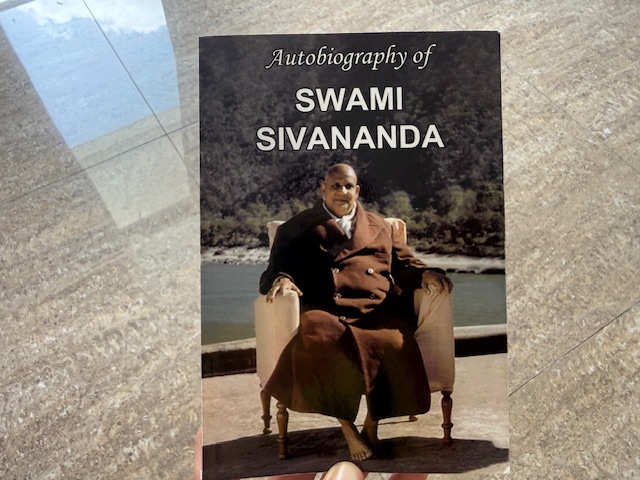
In his autobiography, Swami Sivananda explains that religion cannot be taught or understood by mere argument or discussion, and that “real religion is the religion of the heart.” Observing the Swamis ( the monks) who managed the smooth running of the dining hall daily and the volunteers serving us, with such genuine warmth and sincerity, I began to see what he meant. I wanted to understand and experience what made these souls so light.
Reading theoretical books alone was not going to break down a lifetime of rational skepticism. In the final part of this series, I will share how I challenged myself to step out of the library and into the chanting halls, learning what it truly means to silence the critical mind and surrender to the unknown.
Last posts


Yoga in Mumbai : where Modernity Meets Traditions
“The most powerful practice is often the simplest one — repeated with patience, humility, and presence.” An oasis of Peace and History Sometimes, things just fall into place. A bubbly [...]


My first Yoga Training in Bharat, India
“In the land where yoga was born, the silhouette of Shiva in meditation and asana whispers a timeless truth: mastery begins in the body, but blossoms in the mind.” Arrival [...]


Ode to my gurus
In Sanskrit, Guru means "the one who removes darkness". In a less formal and poetic sense, a guru is simply a teacher or a guide. On the French Wikipedia page, [...]


Born in Paris, Made in India, rooted in Khmer blood
“Mouvement without consciousness is the ruin of the body.” Every movement we make carries weight. When practiced without attention, even the strongest body can accumulate strain and imbalance. Through mindful, [...]