
Ode to my gurus
In Sanskrit, Guru means “the one who removes darkness”.
In a less formal and poetic sense, a guru is simply a teacher or a guide.
On the French Wikipedia page, a guru can be defined as ”a spiritual master, an expert, or a manipulator, depending on the context.”
The Western perspective is interesting because it points to a very real issue in the world of gurus: some are manipulative, and their spiritual appearance serves as a mask to extract money, power, or sexual favors from their disciples. This suspicion did not emerge out of nowhere—it is rooted in real abuses and imbalances of power.
With this in mind, I went to India to deepen my practice, not to find a guru. But I soon realized that a true guru isn’t someone who controls or dominates, they are simply a sincere teacher. I came to understand the power of the term guru and used it out of respect for their presence and guidance, not to feed any illusions. By surrendering to their teaching with genuine openness, not fear or expectation, I began to grasp the essence of Yoga practice.
Now, I would like to share the stories of the teachers I met on this journey and how they shaped the way I practice and teach.
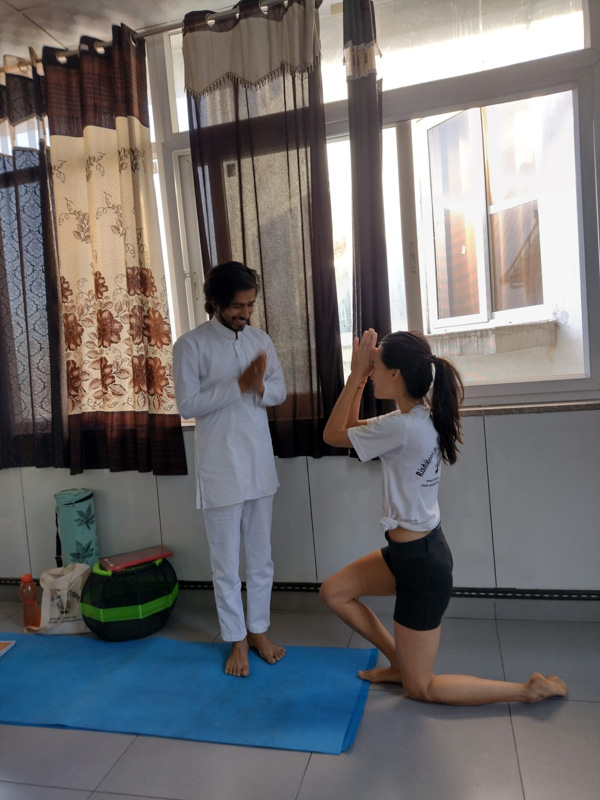
A Guru can be younger : Namaste Sonu Ji, Rishikesh, India
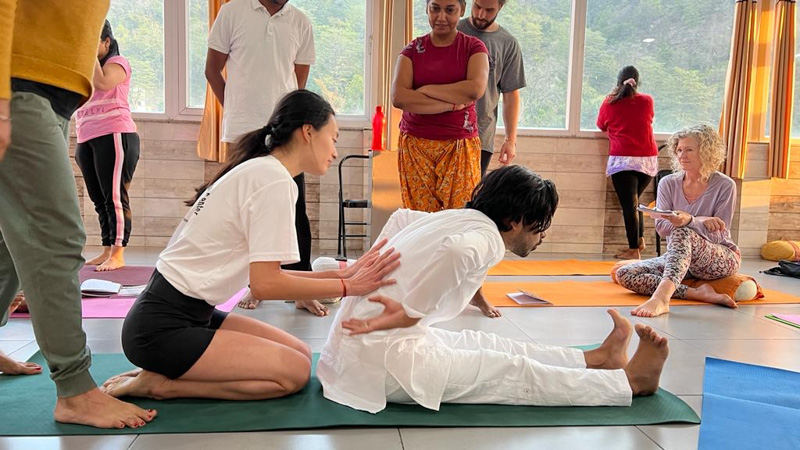
My first ”Guru” was a very young Hatha Yoga teacher: Sonu Ji. In India, ‘-ji’ is an honorific suffix added to a person’s name to show respect, affection, or politeness.
I was attending a Yoga school in the so-called ”Indian capital of Yoga”, Rishikesh, for an intensive training. It was my first time in India. I hadn’t come in search of a guru. In fact my French upbringing had immunized me quite well against blind devotion and spiritual idealization.
Yet from the very first class with Sonu Ji, at 5:30 in the morning, I understood that I was encountering a model. More than his precise and technical expertise of yoga, it was his way of being that deeply moved me. Sonu Ji radiated calm, humility, and inner stability. His teaching – blending mindful practice and clear alignment – found a rare balance between firmness and gentleness.
I realized then that the Yoga I had learned in Yoga studios in the past was not the Yoga I was now practicing in India. I had taken many yoga classes in different parts of the world, with sincere and competent teachers. However, I now see that something essential had often been missing, not skills or intention, but transmission.
In the West, movements were often taught like exercises in a gym, as one might teach a deadlift. What Sonu Ji transmitted went beyond form: through his presence, discipline, and way of inhabiting the practice, something quietly permeated the room every morning.
Under his respectful yet firm guidance, my body and mind began to sense the difference between “doing Yoga” as a physical activity and practicing Yoga as an Art and a Science—the one that emerged in India thousands of years ago.
Yoga is an Art. Like Kung Fu and Taekwondo are Martial Arts. However, martial Arts are inherently linked to combat, often leading, consciously or not to aggressivity.
Yoga, on the other hand, is an Art of Peace.
Not peace as an abstract idea or a moral posture, but peace as something tangible: felt in the breath, in the nervous system, in the relationship to effort and restraint. This peace slowly infused my body and mind through the guidance of a teacher who transmitted yoga not as a performance or a product, but as a path of clarity and balance.
I later understood that part of what made Sonu Ji’s teaching so powerful was his ability to guide without dominating. He offered structure and presence, but encouraged us to find our own path in the asanas. It was his way of mentoring: giving enough guidance to grow, but never taking over the student’s own experience.
After meeting and practicing with Sonu Ji, I kept traveling and practicing in different parts of India. Along the way, I found myself quietly observing how different teachers guided their students. Their style, their body language and the way the class felt. I was learning, almost unconsciously, to recognize what makes a teacher truly inspiring versus ordinary. And then, in the sprawling city of Mumbai, I met my next guru, Sheela ji…
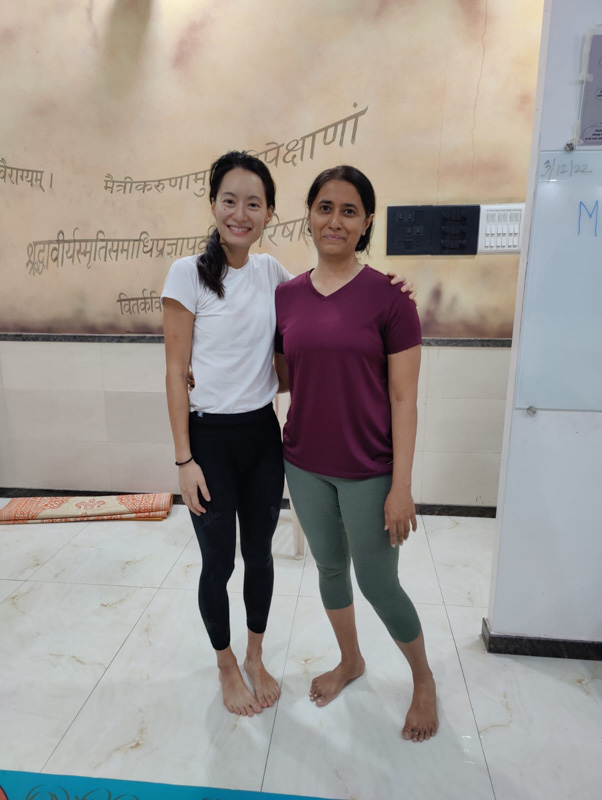
A Female Guru, in the Bustling City of Mumbai
We sometimes imagine finding a guru worthy of the name high up in the Himalayas. My next guru was awaiting in the busy city of Mumbai. Mumbai was a city I desperately wanted to avoid, imagining chaos, noise, a human anthill.
I wasn’t completely wrong. The Yoga Institute where I dropped my bags for an intensive three-months training was located right next to the international airport. Yes, we could hear and see the planes taking off right next to the Institute’s windows. As someone with very light sleep, who sleeps every night with earplugs, the idea of hopping on a plane to a deserted island crossed my mind on my first night…
In the end, I’m glad I didn’t listen to that voice. Because it was there that I had met passionate teachers who would shape in me a Yoga far removed from what is taught in most “modern” Yoga studios around India and the rest of the world.
It was at the Yoga Institute, the oldest organised Yoga school in the world, that I met the woman who would have a major influence on both my practice and my way of teaching: Sheela ji. She was not a white-bearded fifty-something draped in a long dhoti like Sadhguru. She was a woman, a 40 year old mother with long black hair, a direct and childlike gaze, wearing Reebok T-shirts.
The structure of her sequences was an ingenious blend of Hatha Yoga and Vinyasa Yoga. What struck me most about her were her clear, precise, and intelligent instructions. One could move from one posture to the next fluidly, without lifting the head to look at the demonstrators at the front of the room.
I was fascinated by her. It was admiration, pure and simple. When she walked near my mat, my focus sharpened. Her instructions landed in my ears, and my body executed. To this day, I still know each of her instructions very clearly and precisely.
At the time, I didn’t yet question this devotion. It felt natural. Almost necessary.
The fifth Niyama (the Internal Discipline) in Yoga is Ishvara Pranidhana: the complete surrender of our actions to a higher entity. This Niyama had always felt vague and troubling to me when I first heard of it. I considered myself an atheist/buddhist with no one above men and women – we alone were responsible for becoming a Buddha – or not.
Yet when I practiced at the feet of my Female Guru, it felt as though my body no longer belonged to me, as if my movements responded entirely to the sound of her voice, like a form of self-abandonment.
It was both reassuring and humbling to do something without expecting any reward.
My intentions were pure and sincere. I wasn’t trying to push “further” into any asana, always prioritizing joint health, progressive strengthening, and comfort in each posture. Under the guidance of Sheela ji, strangely, when one might expect a desire to impress a beloved teacher, I felt no such urge. My movements slowed, becoming more deliberate, making my practice more intentional.
I think it was the softness of Sheela ji’s voice that held that power over me.
This period of devotion invited me to look more honestly at power, projection and personal insecurities. I understood how easy it is to fall under the spell of a charming and manipulative guru.
In my case, Sheela ji was not trying to manipulate anyone. She was almost shockingly normal: married, with a son, living a simple, ordinary Mumbaikar life. Sheela ji taught her class and left. No lectures. No philosophy.
The practice itself was the philosophy of Yoga.
As the end of my stay in Mumbai approached, I wanted to take as many classes with her as possible, even sneaking into sessions she taught for other groups. One day, when I asked for another ‘private class,’ she simply replied: ”Why? You already know everything.”
Of course, I didn’t know everything. But I understood her message. She was telling me to trust myself.
She was refreshing. She fit my own vision of yoga: just practice, no talking.
Namaste and Merci
Years later after these experiences, what stayed with me wasn’t devotion to a Guru, but devotion to practice.
Today, everytime I practice, I honor the knowledge these Gurus shared with me. When I join my hands in namaste near my heart at the end of a personal practice, I thank all the teachers I have ever had—not only to Sheela ji and Sonu ji but to every teachers I have learned from, whether for an hour, a month or a year.
All of them have left a mark on my life and my practice. This connection through Yoga is the true beauty of the practice.
This chain of transmission, if we traced it back, could lead all the way to the ancient Gurus of the Himalayas. Thinking about this fills me with deep humility: we are no solitary island in the middle of the sea… at least if we want to grow exponentially on the path of Yoga and Life.
“Confidence, clarity and compassion are essential qualities of a teacher.” B.K.S. Iyengar
Last posts


Yoga and Cycling : How Yoga Made Be A Better Cyclist
Part I: The Body — How Yoga Complements Cycling How yoga can improve mobility, body awareness and balance on and off the bike. I used to think that cyclists in [...]
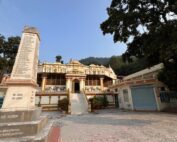

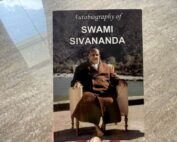
My week at the Divine Life Society (Sivananda Ashram) : Part III
"Sow love, reap peace. Sow meditation, reap wisdom" - Swami Sivananda From Hatha Yoga to Bhakti Yoga I practise Yoga postures (Yoga Asanas) almost every day, even if it’s just [...]
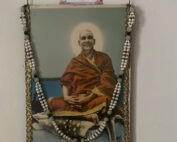

My week at the Divine Life Society (Sivananda Ashram) : Part II
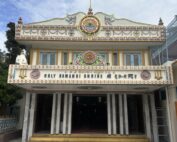
“Fewer the thoughts, greater the peace.” Swami Sivananda Arrival at the Ashram After a long journey by bus and then by rickshaw, I arrived in front of this orange facade [...]


My Week at the Divine Life Society (Sivananda Ashram, Rishikesh) Part I
"Let your eyes look with kindness, your tongue speak with sweetness, and your hand serve with softness" Swami Sivananda During my last trip to India, I had the incredible opportunity [...]


Serving a Vipassana Course: The Ultimate Yoga Practice
Anyone who has completed a 10-day Vipassana course alongside a dedicated yoga practice will tell you: Vipassana is the holy grail of Yoga. You can read about my first Vipassana [...]

Yoga Is Not Everything
When I chat with students or people who would like to start Yoga, I sometimes hear: "I need to do yoga." This use of the word "need" makes me thoughtful. [...]

Beyond the Postures: Svadhyaya and the Practice of Looking Within
"svādhyāyād iṣṭadevatā-samprayogaḥ" Sutra II.44, Yoga Sutras, Patanjali "From self-study comes communion, or alignment, with one's chosen deity or higher ideal" This sutra (verse) gives the explanation of the concept of [...]


Teaching Yoga in a Resort in Cambodia
I moved to Cambodia with a naive dream: to connect with my roots. Being born in Paris to Cambodian parents, growing up in France, and studying in Germany. I was [...]


Is Yoga A Sport?
Yoga Is Not a Sport - Said My Doctor I started Yoga with a few irregular sessions in a yoga studio in North Shore Auckland and online. At the time, [...]
My First Vipassana Retreat
On a quiet night beneath the Bodhi tree, Gautama Buddha closed his eyes—not to escape the world, but to see it so clearly that suffering itself dissolved. My journey from [...]